"When the accumulation of wealth is no longer of high social importance, there will be great changes in the code of morals.
We shall be able to rid ourselves of many of the pseudo-moral principles which have hag-ridden us for two hundred years, by which we have exalted some of the most distasteful of human qualities into the position of the highest virtues"

( JM Keynes, "Economic Possibilities for our Granchildren" 1930 )

Showing posts with label income distribution. Show all posts

Sunday, May 6, 2012

The Parveh Economics of Inequality

“Parveh” : Neutral food, not meat and not dairy ( from the Jewish tradition) is a term used to describe a neutral opinion or position . "Sitting on a fence" 

Prof. Krugman (Nobel Prize 2009) published in his column at the NY Times an interesting post http://www.nytimes.com/2012/05/04/opinion/krugman-plutocracy-paralysis-perplexity.html talking about the relation between Inequality and the Crisis. The line of reasoning of the article reveals the growing understanding that inequality is a factor to be taken into account, but its development goes, as usual to the Partisan arena ( i.e. the Republican bad guys) thus missing the main political and economic conclusions. Put it in other words, a step forward, but still a small one.

The article opens with the following statements ( Note : I make use of one article and one author but the issue is not a personal critique).

“Before the Great Recession, I would sometimes give public lectures in which I would talk about rising inequality, making the point that the concentration of income at the top had reached levels not seen since 1929. Often, someone in the audience would ask whether this meant that another depression was imminent. Well, whaddya know?”….

Did the rise of the 1 percent (or, better yet, the 0.01 percent) cause the Lesser Depression we’re now living through? It probably contributed”.

The statement “probably (“Probably = almost certainly; as far as one knows or can tell”, from the Oxford Dictionary) contributed” is rather “Parveh”, even trivial. We should already know that any social phenomenon is a potential “ contributor ” to a major economic crisis .The really deep interesting question is not the contribution per se but the relative importance of the phenomenon . Was it determinant ? What are the other components that contribute to the recession? And so on ….

Prof. Krugman continues

“But the more important point is that inequality is a major reason the economy is still so depressed and unemployment so high”.

The reasoning here is a bit confusing: When the question was from the “contribution” ( i.e. cause) side, inequality was a just mere probable contributor. Now when we deal with the solution side, inequality becomes a ” major reason” that impedes to return to normal growth. What a change! Common sense indicates that “cause” and “solution” in any question are correlated, in our case if inequality is now a major depressor, shouldn´t we to expect that it may be also a major detonator for the crisis? The answer to the apparent inconsistency appears now, in the text.

From now on , and for the rest of the article the focus of the debate turns from Economics to the partisan arena. Since the political color of the writer is well known, the main attack is against the Republican Party (as if the Democrats were some sort of Social Democrat part y or it members were not also part of the American oligarchy) . So if the writer is not able to throw even a small stone on his own political house, there is nothing really surprising in his words. Now we understand that inequality is a problem because the Republican Party is owned by a small mega rich group that impedes a normal political debate with the good souls, the Democrats.

Finally, when it comes to the solutions, the writer returns to the old Keynesian creeds leaving.

“Many pundits assert that the U.S. economy has big structural problems that will prevent any quick recovery. All the evidence, however, points to a simple lack of demand, which could and should be cured very quickly through a combination of fiscal and monetary stimulus.

No, the real structural problem is in our political system, which has been warped and paralyzed by the power of a small, wealthy minority. And the key to economic recovery lies in finding a way to get past that minority’s malign influence”.

So for the Economy , Keynesianism and for politics to get rid of the malign influence. Once again, the logic is confusing: If the problem is an excessive political concentration of power due to an excessive concentration of wealth, shouldn´t we deal with the cause? Why there is not an explicit call to deal with the root of the problem by reducing inequalities? Why to stick only to the traditional instruments of Keynesianism and not to mention that equality was a major component in the New Deal?

Summarizing, there is a renewed interest in distribution aspects, but mainstream economists are still unable to propose a political economic agenda in that direction in economic terms. Maybe because the Parveh mainstream economists are unable to deal directly with the Taboo? Who knows... the  fence is already too (intellectually) fragile, and Economists should understand that the days that distribution was a taboo are over.


Friday, January 27, 2012

Davos Proposal of "Free Work" = Slavery?

From Davos Conference ( January 2012)

"Young people should work for free for up to two years to gain experience, youth and business leaders said at the World Economic Forum in Davos Thursday.
A new UN resolution to enshrine the importance of a couple of years of voluntary work for young people was urged by delegates including Maurice Lévy(1), chairman and chief executive of Publicis Groupe, as part of a CNBC-moderated debate on how to avert a lost generation of unemployed youth...”. (http://www.cnbc.com/id/46152716)

Youth unemployment is indeed A PROBLEM, in several countries of dramatic magnitudes (ex.: The level of YU in Spain is close to 50%). So, in that case the issue at stake is not how to define ( or recognize) the problem but how to deal with it. As a matter of fact, innovative ideas  have been already "put on the  tables" ...

Sunday, January 22, 2012

Globalization : The Unfinished Job


The reference for this post will be a recent article titled “Charity needs capitalism to solve the world’s problems” ,written by former US President Mr. Bill Clinton (“Financial Times” website). The article opens with the following statement:

“Charity alone will not solve the world’s problems. Capitalism can help and at the same time put people back to work……” (FT , January 20, 2012)

The cooperation plan between Capitalism and Charity are explained along the article, resumed in one of its ending paragraphs.

“These efforts ( of Charity and Capitalism E.F.) benefit both the communities they target and the corporations and philanthropists involved, diversifying their businesses, expanding their markets, training more potential workers and helping to create a culture of prosperity. All this enhances profits, increases economic inclusion and gives more people a stake in a shared future”


Mr. Clinton actually offers a “Win- Win” deal: Achieving a moral end (“Solve the world problems”…. “Gives more people a stake in a shared future”) by appealing to the Capitalist intuition of profits seeking, a deal adorned with an unequivocal MBA new speak (“Diversifying business….expanding markets…training potential workers…). Social responsibility at its best!

In the philosophical sense, there is nothing really new in Mr. Clinton words. The idea a moral end (such as general prosperity) can be achieved through the pursuit of self interest has been already expressed some 250 years ago by the Philosopher/Political Economist Adam Smith.

It is not from the benevolence of the butcher, the brewer, or the baker, that we expect our dinner, but from their regard to their own interest. We address ourselves, not to their humanity but to their self-love, and never talk to them of our necessities but of their advantages” (Adam Smith. An Inquiry into the Nature and Causes of the Wealth of Nations)

These 18 century ideas were developed on later decades, becoming the pillar of free market ideology, the foundation of the Globalization for the last 20 years. If so can Mr. Clinton call for a “Capitalism and Charity” system considered as an implicit recognition that the original version of “Smithian” Globalization (launched along his own Presidency years…) actually failed ?

In order to answer the question we address the question what Globalization is all about?: One possible answer is "… (Globalization) When used in an economic context, it refers to the reduction and removal of barriers between national borders in order to facilitate the flow of goods, capital, and services and labour... (UN agency (ESCWA) From the Wikipedia)

True, barriers to Goods, Capital and Services were (partially) removed: The globalized world allows you an easy transfer of money abroad, the purchase of foreign currencies and/or financial obligations…. Alternatively when landing in a remote country you will find out that you and the native share not only the “human condition” but products, services, and corporations so familiar at home.

But, the above definition got another twist. UN agency is aware that “….although considerable barriers remain to the flow of labour... “

The observation that our “Globalized World” still impedes (20 years since its launch…) from human beings to move freely in the search for a decent life abroad is self evident. Still, the exclusion of labor from the free movement scheme has serious consequences on the whole Globalization edifice.

The theoretical framework of Globalization (or free markets as a general frame) requires that ALL production factors and products should be allocated freely. ALL. Theory can easily demonstrate that restrictions on freedom impacts competition, prices and quantities, all for the worst. Moreover, if the free movement of one “player” in the model is being restricted, the rest must be accommodated, even restricted, something that could unleash a dynamic of more restrictions and protectionism. In other words, Game over….

So, if the outcome from restrictions on labor is BAD, why the system operates this way? Well, it could bad for all,,,, but good for some players . The answer lies in the relative position of the countries and the short term benefits. Rich countries, the ones who dominate the scene have plenty of Capital and products in relation to their workforce. From the other side, Poor / Developing countries have to offer in that scheme plenty of labor and relative shortage of Capital.

It is turning to be a longer than planned post…. So in a very shortly comment, labor restrictions ( in addition to the imposition of production quotas on some products … that is another story …) favors rich countries as it permits to export their excesses and create a two tier production/ consumption system, poor workers vs. rich consumers .That is the main line that explains the widening gap between countries, that feeling we share with Mr. Clinton that his Globalization did not deliver the expected welfare fairly . Just have a look on wages, prices, working conditions, social security nets around the world to understand the bridge, better put the abyss between countries.

So, instead of embrace a half baked Capitalism/Charity ideas in the spirit of Mr. Clinton article, maybe the world should go a step forward and implement a full globalization and fair scheme, without restrictions simply frictionless as possible. The economy will do the rest, and no need for charity.

Even Mr. A. Smith would agree with such proposal. How do I know that? Last quote for today…. (the outlines are mine )

"It is not by the importation of gold and silver, that the discovery of America has enriched Europe. ...The commodities of Europe were almost all new to America, and many of those of America were new to Europe. A new set of exchanges, therefore, began to take place which had never been thought of before, and which should naturally have proved as advantageous to the new, as it certainly did to the old continent. The savage injustice of the Europeans rendered an event, which ought to have been beneficial to all, ruinous and destructive to several of those unfortunate countries." (An Inquiry into the Nature and Causes of the Wealth of Nations, by Adam Smith : Book IV: On Systems of Political Economy Chapter I: On the Principle of the Commercial, or Mercantile System )

Wednesday, January 11, 2012

Deleveraging , Debts and Distribution

Most economists are already convinced that years of massive stimulus spilled on the economy yielded just minor economic results: In any case far from what can be regarded as “Recovery”. Why? Many are the obstacles the economy is facing, though it is widely acknowledged that the private sector heavy indebtedness and its "Deleveraging" .....

Friday, December 30, 2011

On Competitiveness and Salaries - A European Note

Most mainstream economists agree that the deteriorating condition of the Euro is the outcome of the differences between the EU countries . The perception the Union as it was formed actually deepened the structural economic “imbalances” between a thrifty “North ” and a profligate “South," while lacking the correspondent policy tools which counterbalance those deficiencies .

The "imbalances" and the proper short run policy response have generated a heated debate among the political and economic circles in Europe. Needless to say that any outcome from the European deliberations will have an impact not only on the Continent but on the global economy. However, there is almost no doubt that for the medium and longer run , the “South” must restore its “competiveness” in order to avoid a second round of economic imbalances. So “Competiveness” is THE core issue to be resolved.

What is competiveness all about? The idea behind the “competiveness” theorem is that the last decade brought about excessive wage increases in the South which eventually caused the loss of a competitive edge vis a vis the North and the rest of the World. The result was the formation of unsustainable massive deficits , private and public as well. . Therefore , as we are told , THE logical solution is to reduce wages and / or improve productivity to avoid these deficits and financial crisis. Is it's so? Are really wages and salaries the real reason for the crisis?

One way to analyze the issue is to compare identical products and see their costs structure and selling prices : A product is sold for a price and the cost is divided between labor and capital and profits ( 50, 50). If Labor cost increases, lets say to 60 , and you want to maintain the 50 profit, the price must increase to 110 . (In that case the RELATIVE weight of labor also increases).

The same logic applies to the national economy: GDP, the “product” of an economy is roughly split between its "costs" i.e. Labor in the form of wages and Capital in the form of interests, amortization and profits . If the labor share increase, it means that in relative terms the worker take a bigger slice of the economy ( and vice versa) .

The following graph which compares two representative countries ( Spain vs. Germany) i.e. the typical “North” and “South” Economies in terms of salaries and labor share speaks for itself


Based on data extracted on 07 Dec 2011 from OECD. Stat ( Annual Income Share real ULC)

The interpretation of the graph is very simple. Any competitive misalignment between the two countries cannot be attributable ONLY to the Labor costs. I will make use of a simple numerical example to illustrate the point: Suppose that in the 80 a German and a Spanish car car were both sold at 10 k Euros. In such case workers got Ap. 7500 Euros ( “labor share”) of it and Capital got the balance, i.e., 2,500 E . If there was no change in the relative prices, in 2007 workers received only Ap. 6,400 Euros and capital 3,600 . Now, if Spanish cars became more expensive and lost competiveness, lets say 11k, part of the blame for the price increase MUST be attributable to Capital as they got for sure more than 3600 ( in our case 3960 E)

In other words, what the figures tell us is that any competitive loss, if there was any such phenomenon of the Spanish economy was necessarily, among other factors the outcome of higher profit rates. Therefore the burden of any alignment process should be bear ALSO by Capital. The calls to reduce salaries in order to restore competitiveness are economically wrong and morally flawed, as Capital enjoyed a 30 years period of a genuine Bonanza.

This graph also tells us something about the importance of adopting a cross borders perspective. If the European working people adopted a pan European perspective, for example by advocating the increase of labor share in each and every country instead of adopting a sort of national perspective, all the working people, including the Germans ( and the rest of economy as well…) could gain from such common stance. But let´s leave that for another blog ….

Wednesday, December 28, 2011

Worse than the 30, Ms. Lagarde, Worse ! (or “The Crisis” from an Historical Perspective)

A couple of weeks ago we got another public warning about the state of the Global Economy. This time the warning call was launched by a top economic figure,the Managing Director of the IMF ,Ms. Lagarde.

IMF chief warns over 1930s-style threats
The managing director of the International Monetary Fund has warned that the global economy faces the prospect of economic retraction, rising protectionism, isolation and . . . what happened in the 30s (Depression)

http://www.ft.com (By Hugh Carnegy in Paris, George Parker in London and Peter Spiegel in Brussels – December 16th 2011)

Now, is it reasonable to deliver a dramatic warning about our modern economy alluding to events which took place some 80 years ago ? The answer is yes, as long as the events share some common patterns . So, the question is not whether 30 and 2011 are identical (obviously, they are not not) but if they share meaningful similarities.

Most economists would agree that both events share important common patterns : Generally speaking, both crisis were preceded by a period of economic “prosperity” accompanied with an Asset/Debt bubble . Consequently the violent pricking of the bubble turned into a debt crisis ( i.e. Debt suddenly became unpayable) ,which affected aggregate demand and financial stability. The policy response ,in both cases, was a massive support to the financial institutions and injection of "real" demand through expansionary policies (monetary and fiscal as well).

Up to now, I agree with the analysis, though my reading goes a step forward ( to an area that most mainstream economists simply ignore): I claim that the bubble and the following crisis were in both cases the outcome of a distorted income distribution, skewed toward the upper income echelons ( I´ve wrote extensively about it, so whoever is interested in understanding that point is invited to read previous posts).Anyhow, to illustrate my point please look at the below graphs dealing with the US and think for yourself if there is no place for such hypothesis.... . In an Hamletian style we should say “ To Distribute or not to distribute : That is the question...” . Needless to say the solution lies in recognizing that simple message.

Top 10% share in Income US

Total Debt - US

The conclusion is that Ms. Lagarde is quite correct by applying an historical perspective when she delivers her warning. However, as “History does not repeat itself, but it surely rhymes” it would be erroneous to confine our understanding to “Similarities” between “Then” and “Now”; a proper historical narrative should draw our attention to the role of dissimilarities as well.

Coincidence or not, last week turned to be the 20th anniversary of the collapse of the USSR. Are Ms. Lagarde statement and the anniversary related ?

Well, for me the answer is YES. The main difference between 1930 and 2011 is in the political arena: The world of 1930, a minute before the spreading of The Plague (Fascism ,Nazism) was obsessed with the new economic and social alternative model represented by the Soviet Union . Regardless our views on the Soviet Regime during its Stalinist phase, the Soviet model was back in the 30 perceived as a serious alternative (or threat) to the Capitalist order. And here lies THE dissimilarity: Ever since the collapse of the Soviet Union 20 years ago, the dialectic challenge to the dominant regime on a global scale has been absent from the political arena. The result : A new wave of Globalization, an accelerated dismantlement of the Welfare State … and so on.. but this is another story for another post.

And how this difference is related to the economic arena? Lets see how the main mentor of the reform policies in the 30 , Lord Keynes and FDR , regarded their work :

"The broad thrust of his (Keynes) efforts, like that of Roosevelt was conservative, it was to endure that the system would survive"( JK Galbraith)
"The Class war will find me on the side of the educated bourgeoisie" ( JM Kyenes)
“Red Russia holds too much which is detestable" ( JM Keynes)

As can be seen, the whole concept of intervention in the economy, seen by many as a "Socialism" was considered by the its main promoters as than an attempt to save the system of private property (i.e. Capitalism). From whom? The main threat was in the East, the USSR , with its fast industrialization, GDP huge growth , and all of that before the Stalinist crimes became widely known ( BTW, THE problem with the USSR was never the lack of freedom: Just remember how the US supported for decades more than one authoritarian conservative regime around the Globe ….). FDR or Keyens were aware of the challenge imposed on the System and reacted accordingly.

As of our modern times , the Economic system lacks any real drive to reform itself as there is no imminent threat around : No Soviets, no reds.... If so, why to bother to reform? Even Keynes and Roosevelt would agree on that . The results of that tragic myopia can be observed in the half baked reforms “imposed” on the financial system (still (!) able to create exteremely wealthy bankers), .... high unemployment rates with no real policy response ....the endless summits in Europe rushing to decide something before the opening of a new trading session… and above all the return of the Austerity talk with its Deficit Hysteria….( if deficit is the problem , why not to raise taxes ???? ) . As we can see, anything is valid as long as it does maintain the current state of affairs, ironically, the very same system that proved to be fragile and unstable.

The problem is that for the mainstream economists and policy makers there is no myopia, as they are in the game for THAT reason, i.e. to protect the system, not to reform it. However it IS a myopia if we agree that the main problem to be resolved is not “Debt” ( which is by definition, other´s people Asset) but inequality and income distribution . It is a myopia for those who remember the 40 .....

Share of Top out of National Income ( OECD Figures)

My conclusion is that under the current state of affairs, absent political threats or serious social alternative, the Elites will not give up upon the privileges gained along the last 3 decades. Without the drive for reforms , the Political and Economic response will be an anti Keyensian / FDR wave i.e. more Orthodox and austere policies to reduce deicits and public budgets. Even Noble prize winners agree that such policies are a certain recipe for disaster in the midst of deleveraging and weak private demand. ("Keynes Was Right" by P. Krugman)

Such tragic path could lead to a permanent recession mode and a worse economic long run consequences than humanity experienced some 80 years ago. And let us not forget that even the relative mild policies of the 30 were not able to prevent by “new” dawn on September 1st 1939….( WWII)

Sunday, March 6, 2011

Garbage Out , Please

"Garbage In, Garbage Out" (GIGO) is a phrase from the field of computer science commonly used to describe failures in human decision making due to faulty, incomplete, or imprecise data. (Wikipedia). However, the application of GIGO to human behaviour overlooks the fact that for humans the “GI” part depends not only on “real” data but (mainly) on how reality is perceived. Moreover, we are able to adopt “GO” attitudes even it is evident that the hard data support a different conclusion.

Lets take for example the attitude toward a main social issue as “Income Distribution”: The following graph reveals one of the result of a survey about the attitude toward inequality in US. America is just a mirror, an example for other countries.


Source (http://motherjones.com/politics/2011/02/income-inequality-in-america-chart-graph) from “Building a Better America – One Wealth Quintile at a Time by Michael I. Norton Dan Ariely Harvard Business School Duke University)

The results are very interesting: First, Americans perceive that social inequalities in their country are less acute than really are that “…..First, respondents dramatically underestimated the current level of wealth inequality” . I would say that “underestimated” is an underestimation.

First of all, wealth is regarded as the Direct command over money, but does not include indirect command. For example, under the modern shareholder structure , whoever holds just of a small portion out of the shares of a company is practically the one who holds the command over the overall company´s assets, much above his "real" holdings. That mechanism is denominated as the “OPM” (“Others People Money”) principle. And since Capital accumulation is not just a matter of bank account but of command, for practical matters the pecuniary figure becomes an underestimation of the real power behind Wealth.

In addition , the “Wealth” definition is somewhat misleading. According to the article “Wealth, also known as net worth, is defined as the total value of everything someone owns minus any debt that he or she owes. A person's net worth includes his or her bank account savings plus the value of other things such as property, stocks, bonds, art, collections, etc., minus the value of things like loans and mortgages.”

The problem with the above "Wealth" definition is that it includes personal house, which is not a typical “asset” but a sort of consumption item which is financed over a long period and does involve a command over future income streams ( as a typical financial asset should). Thus if we exclude housing from “Wealth”, we get an even worst picture of inequality as the lion share of the lower classes wealth is mainly their personal home.

The second conlusion “Second, respondents constructed ideal wealth distributions that were far more equitable than even their erroneously low estimates of the actual distribution…”

In clear contrast to the image of an ultra individualistic society: Most American citizens favour a more equal social model than they perceive, evidently much more equal than it really is. They favor a Swedish model society!

So if so many people favour a much more equal social model, how it comes that the actual state of affairs is so different to their ideal? Well, the article does not give a comprehensive answer to that question but on my opinion it´s about perception and its relation to what I call the “tolerance zone” . People generally tend to be pragmatic and would a reality that differs from their ideal as long as it falls within the boundaries of their "tolerance zone". For example we might not like exploitation but we can live with it until certain point.

Therefore perception is a fundamental piece in the social structure of inequality.If people REALLY understood that they live in a much more polarized society, some of them would not be ready to accept it ( i.e. it´s out their tolerance zone) and favour changes in the social structure.

Moreover, Democracy relies on free and accurate information that influence our decisions: if we manipulate data, freedom of decision becomes a fiction. So whatever our political view about inequality is, any genuine Democrat should support a free and accurate flow of information or in other words that there is as less as possible Garbage in the INPUT DATA , so whatever GO we get , we can at least be sure that it was not the outcome of a GI but from an internal BUG in the system.

Sunday, November 7, 2010

Who Cares About Growth???

Sometimes I´ve got the strange feeling that Analysts, Policy Makers or Economists have signed an unconscious agreement: Under any circumstance, no matter what they are asked about the econmy , they alwaya return to THE eternal Mantra “(Economic) Growth isn´t everything, it´s the only thing!”. The repetition has its effects , and Economic growth (the rate of change of the national product -“GDP) is quoted, analyzed and commented endlessly as if the whole world was pending on a rather weird and obscure figure. Since most of the population normally tends to listen to “experts” (especially in the field of economics), the GDP talk became a widely accepted yardstick to measure policies, and most important politicians.

Why Growth is so important? And who benefits from the “Growth” obsession? First, the GDP importance stems from its general nature and apparent neutrality, after all the figure measure the well being of the WHLOLE society. So, if GDP grows by 1%, we are “all”, on average, 1% richer. In that simplistic way it is correct though the problem lies in that the “average” citizen simply does not exists. The 1% is the growth of the overall economy, but it does not imply how the somewhat biggest pie is going to be eaten. Some might even receive less than before , even the overall pie has grown.

I would like to illustrate that point by making use of data from the American Economy. The graph describes the evolution of the GDP growth and the share if the most rich 10% of the population for the last 65 years. (Why America? The data is available and it reflects in general terms the trends in other countries).


As can be seen from the Graph, America´s GDP grew almost every year since WWII (exception in recessions) . However, the way the growing pie was distributed can be divided into two main periods. Along the first 30 years after WWII the relative share of the richest 10% citizens was stable (app.30-35%). Since the mid 70 the top 10% slice grows steadily and dramatically, and nowadays they grab almost 50% of the national income. If you want to see it in another way, 10% of the population received 60 cents of the additional wealth created during those 30 years, while the average citizen in the lower parts (the rest 90%) received 4 cents.... 60 vs. 4!.

So, if politicians and mainstream media are so obsessed with growth it must be because they care a lot about the 60% share, otherwise there is no reason why to focus mainly on that figure. As mentioned above, this is data from the American Economy, but it is possible to track the same trends in many other developed countries. Some would argue that “they deserve it “ i.e. the most top 10% are the guys that work hard, innovate, assume risks .. in effect they are the drivers of growth so they deserve a bigger share , while the bottom 90% should be thankful for getting almost 50% of the additional wealth.

Needless to say that such argument is so poor and based upon debatable hypothesis as what is growth and justice. However that argument can be easily refuted with our simple graph. If the only condition to growth is an ever increasing share for the most talented, can someone explain what happened between 1947 and 1977?? The American economy not only grew vigorously but 30% more than the following 30 whilst the “talented” share remained stable. QED

The way growth and well being is distributed should not be confined to the “moral” arena, far away from the “practical” sphere. Living together in a society implies a general, sometimes , vague, common reception of ethical values , justice and fairness . However, my point goes beyond that : The very fabric of the modern society and economy is based upon sharing the benefits of the economy : The wealth as expressed in financial assets and other depends on the capacity of the mass consumer to generate sales , profits and wealth. A polarized society with an insufficient purchasing power of the average citizen is a weak growth society which tends to rely upon external demand ( the model adopted, for example , by China ) or to engage in an endless speculation orgy of extravagances and that sort of things. In a next blog I will try to link the current trend of income and wealth accumulation and the current economic crisis.

As a finish line, I will just ask you a favor : Next time you hear a debate dealing with growth and GDP, just ask the most natural question , the basic moral imperative of an individualistic and capitalist society : What do I get out of it ??? Although I do not know you personally, I can tell you with 90% probability that you will get almost nothing….

Sunday, October 24, 2010

Who is Afraid from Deflation??

For many decades economists and policy makers have labeled inflation as the main threat to stability and growth. Accordingly, policies were designed and applied to fight that threat, even when the Big War meant sacrificing other policy goals such as employment. However, the last recession revived the threat of deflation (Generalized decline of prices), until such a point that the “D” word has replaced the “I” word as the main enemy for the economy.

How it comes that Deflation turned to be the new economic “Ghost”? Mainstream economists and media offer various explanations for sudden shift in their attention, some of them to be exposed hereinafter.

The First of all , almost everyone point to the “Japanese Ghost”, a living example of a country that fell into a low growth trap following the bust of an immense asset bubble ( AKA “Lost decades”). That trap was accompanied with a steady decline of prices products and assets as well. Japanese Govt. tried to fight the recession with the accepted medicines ( public debts, lower interest rates) with limited success. The Ghostbuster replies: “True, Japanese ghost hit assets owners quite a bit ( Nikkei is still 35% from its peak in 1990) but unemployment rarely passed the 6% ,a figure unemployed American can only dream about. Anyhow, despite the “calamities” Japan is still one of the most advanced countries in the world . From a methodological perspective, casualty does not mean causality, so the anemic growth can be attributed to other factors such as income distribution... or job security , just to name a few, while falling prices are in classical economics the result , not the cause of the real world. So where exactly is the Ghost?”

From Japan we turn into theoretical “Spiral Ghost”. That theory claims that falling prices induce people to postpone their purchases since the consumer expects to get a better deal later. Since consumption accounts for ap. 70% of the economy, lower consumption means lower sales, less production and more unemployment, pushing prices down in an endless spiral.The Ghostbuster replies :”Unfortunately that Ghost cannot live in the same room with basic economic theory. We were told from the first day in the University that when a price of a product falls, the quantity demanded for it increases (“The Demand Curve”), so deflation ironically should augment consumption, not depress it. The focus on “timing” of that argument is another evidence for shortsightedness and misunderstanding the importance of prices as a market mechanism to calibrate between needs and capabilities. If prices are too high,it´s about time to reduce prices ( and profits.... ) so we all can enjoy prosperity. Sorry I don´t see any ghost around”.


Others mention the “Real Interest” ghost. That argument is focused on investment and consumption and their relation to interest rates and it goes like this : If prices fall, than the real interest on debts goes up. Since nominal interest must be above zero, falling prices mean (G-d Forbid!), positive interest rates. Such rates would restrict consumption and investment, eventually deepening the recession. The ghostbuster, still unemployed and a bit frustrated replies “ The very same pundits have told us that the crisis was provoked by a low interest rates policy held for too long tha fed a consumption and financial orgy which ended in the actual disaster. Now the very same experts want to apply the same poison? And we will end in worst recession nightmare later on? Are these guys serious? In addition, who will invest when 30% of the production capacity is idle?. Next , please ….”

If the Ghosts named above are not so real what is the real motive behind the implacable fight against Deflation? Nobel Laurate P. Krugman was very precise when he explained his vision in favor of inflation ( = against deflation) in an article published two years ago in the NY Times titled “ The case for Inflation”

“It goes like this: even in the long run, it’s really, really hard to cut nominal wages. Yet when you have very low inflation, getting relative wages right would require that a significant number of workers take wage cuts. So having a somewhat higher inflation rate would lead to lower unemployment, not just temporarily, but on a sustained basis”. (NY Times, “The case for Inflation, February 2010)

We should thank Pr. Krugman for his honesty. What he says in simple words is that since accepted ( and contractual) employment conditions of working people are too difficult to overcome, the “solution” is to bypass that obstacle by eroding their purchasing power . Applying Krugman´s logic, if instead of inflation we get a small deflation, real wages will surge . So, if low inflation is the cure which reduces real wages ( his main concern!), than the Ghost is ...high wages! . Eureka! . As a side notePr. K “forgot” to tell us that lower wages imply by definition higher profits to corporations. Well, that is just a “detail”....

Our professor is not alone, as that sort of “analysis” follows a long academic tradition of associating economic crisis to “high wages” or “low productivity” to which the “cure” is self evident :Low wages encourage employers to hire personnel, and reduce unemployment rates. Such “theory” is another sad example of how the “micro” perspective depict a twisted macro picture of the whole economy.

Let me explain. Right ,from a perspective of a small company higher wages mean more costs and probably lower sales. However, a macro economist should ask not only how the stuff will be produced but who is going to buy it .... and if the mass consumer looses purchasing power due to depressed salaries and buy less, the real gain of the capitalist is a Pyrrhic victory..

So the real ghost that bothers policy makers is not Deflation per se but another “D” word, “D”istribution , the possibility that in some point working people can enjoy a bigger share of the global prosperity. Do workers earn “too much”? Well, even Professor Krugman knows that the wage share out of national income ( i.e. the part of the national wealth that goes to the working people) is in record low in historical terms. Conclusion: Working people do not earn too much, I would say that they even earn less than the necessary to absorb the products offered at current prices, and therefore Deflation might be a good step to recalibrate that anomaly.

As any observer knows, the game of Political Economy is also a zero sum game between Capital and Labor . That implies that any worsening of the Labor conditions implies an improvement for Capital.The evidences that the concern of policy makers in favor of Capital are so evident in their last policy debates and actions, that it cannot be avoided but we will leave that for the next post that will deal with the QE2 initiative.

Thursday, October 7, 2010

The XXX Economy

The E= Y equation should be familiar to any person who attended a basic course in Macro Economics. The equation says that the overall production of a National Economy or “Y” is consumed during the same period of time ( Year , month...), represented by the “E” or Aggregate Demand. The identity sets a sort of closed circle by equating the Economy main parameters under any circumstance (Note even non sold products are considered a sort of non voluntary demand , or unemployment so in any case the identity holds... but lets leave that interesting debate for another post ). Whoever studied economics can skiop the next two paragraphs.

The “E” , the Demand, has three main aggregates : Some products are consumed by us as Private demand (“C”), some as Public demand (“ G”overnment) and the rest remains “I” Investments ( in simple words, the products that are used to produce more in forthcoming periods). The basic equation looks like this:

E = C + G+ I = Y

If we add other countries than the picture becomes a bit more complicated as the circle is opened and the country can sell part of its production abroad ,as Export “X” or to bring products from abroad, Imports “M” . The former is added to the demand and the later is another source of products so it is subtracted from the demand. The new equation looks like this

E = C + G+ I + X – M = Y

Now, back to Planet Earth.... the ongoing recession is a classical case of a Demand crisis ,as the capacity to produce goods and services ( Potential Y) is much higher than what actually people are ready to buy. It is important to note that THE ABOVE EQUATION STILL HOLDS but with unemployment, spare capacity , piled stocks etc.

In order to increase the E and thereby the Y and employment , governments have tried to work with the equation above : First by increasing the “G” generating huge deficits in their accounts ( 800 billions in the US and so on) ended with austerity measures . Another policy applied was to encourage “I” by reducing interest rates ( only yesterday the Bank of Japan announced that it will reduce its interest rate to 0 ) and consumption “C”- ended with record balance obligations in Central Banks loaded with dubious stuff . Least and not last the explicit attempts to maintain asset prices is aimed to sustain “C” (If people feel rich , they consume more ,,, that at least what the theory says) - the end is a more poor consumer , with less employment and less wealth. .

It is natural that All these policies seem to have some influence, but very limited due to the special circumstances and because they do not address what THIS BLOG AND OTHER PEOPLE have been saying for a long time : ONLY A POLICY OF REDISTRIBUTION CAN GURARANTEE A BALANCED, JUST AND SUSTAINABLE ECONOMY. Please read previous posts in case you don´t believe....

Since the above policies are deemed to fail ( as predicted ) and the evidences are against the Green Shots illusion are piling, the last bullet in the policy makers arsenal is to try and get some demand form the outside world , i.e. encouraging Exports (X). The new paradigm is X X and More X ! Though, since it impossible to force sovereign countries to buy your stuff, you must try to convince them by lowering your prices which is equivalent to make your currency cheaper.

It is not that simple to manage currency rates since currency markets are supposed to be “floating” and “free”. Therefore Central banks make use of a serie of methods to lower their currency : Announcement of lower interest policies ( QE 2 in US ) , Lower interest rates ( Japan) , Purchasing of currency ( Japan, Switzerland, Israel) or direct control of exchange rates ( China) . That is what I call the XXX economy, since the export lead recovery is just another pathetic XXX sign , a sort of “we know what it´s there but we don´t want to know about it “ attitude. Nude reality is there after all.

These steps are part of the background for the last violent in the currency markets ( Euro Dollar from 1.6 to 1.18 and back to 1.38 in question of months... high value of the Japanese Yen despite the weakness of its economy ... etc. ) in the last months, and the best is yet to come. Anyhow, the managers of that game are conscious that their efforts are futile : If all the countries are trying to make use of export as a way out of the crisis and all of them apply the same devaluation policy, we will be soon back in the starting point and no effective devaluation will take place.

The futility of currency devaluations lead to an escalation of the attempts to generate demand, tht time by avoiding competition from abroad in stead of looking for new markets . History tells us that in the end some countries simply close their gates to foreign competition in order to maintain some internal demand for its industry. According to some economists, that “Beggar Thy Neighbor “ policy in the 30 reduced drastically the international commerce and exacerbated the impact of the financial crisis as Former US Secretary of Labor R. Reich recently said
“Smoot-Hawley here we come. Willis Hawley and Reed Smoot, you may recall, sponsored the Tariff Act of 1930 that raised tariffs to record levels on more than 20,000 imported goods. The duo said this would protect American jobs and revive the economy. It did the reverse, plunging the nation ( AND THE REST OF THE WORLD .... Blogger note ) into an even deeper depression....”


I could not find better words to end that blog. Despite the gloomy perspective we should not forget that a progressive and reasonable way-out is available. It´s only a matter of consciousness and choice.

Sunday, October 3, 2010

The Dark Side of the Yuan

The political debate in America concerning the “unfair manipulation” of the Yuan by the Chinese Authorities is intensifying . Last week (Sept. 2010) in the House of Representatives a huge bipartisan majority approved legislation that would potentially pave the way for sanctions against China over its currency policy.
Trade Wars? Not yet, to me it looks more as “Election wars” , that sort of initiatives launched a few weeks before elections aimed to appease a furious a population still bearing the burden of a false “Recovery”.

However, the pressures on China to modify its currency policy and adjust it to "market values" are more serious and persistent than a populist gesture. According to many American political and academic voices, the Chinese policy of pegging its currency to the USD has distorted the trade terms between the countries which brought about the loss of millions of American jobs and trade imbalances that helped to create the pr recession financial bubble. According to that view, the artificial low value of the Yuan turns to be an unfair competitive edge which reduces manufacturing costs in Dollar terms at China, forcing local companies to transfer production and jobs abroad. The trade loss is compensated by a flow of money back to USA , inflating the financial bubble.

From a rather simplistic perspective the above description sounds plausible, albeit its logic chain is based upon a serie of debatable hypothesis, one of them related to the concept of a “ fair value” for a currency . In order to overcome that "fairness "obstacle economists developed the denominated “Power Purchasing Parity” (PPP) parameter, a tool that establishes the value of exchange of currencies according to what they are able to really buy instead of their current market value. For example if a cup of coffee in Barcelona costs 1.2 € and the same cup of coffee in America costs 1.2 $ , the effective exchange rate should be 1 (1.2/1.2) and not 1.35.

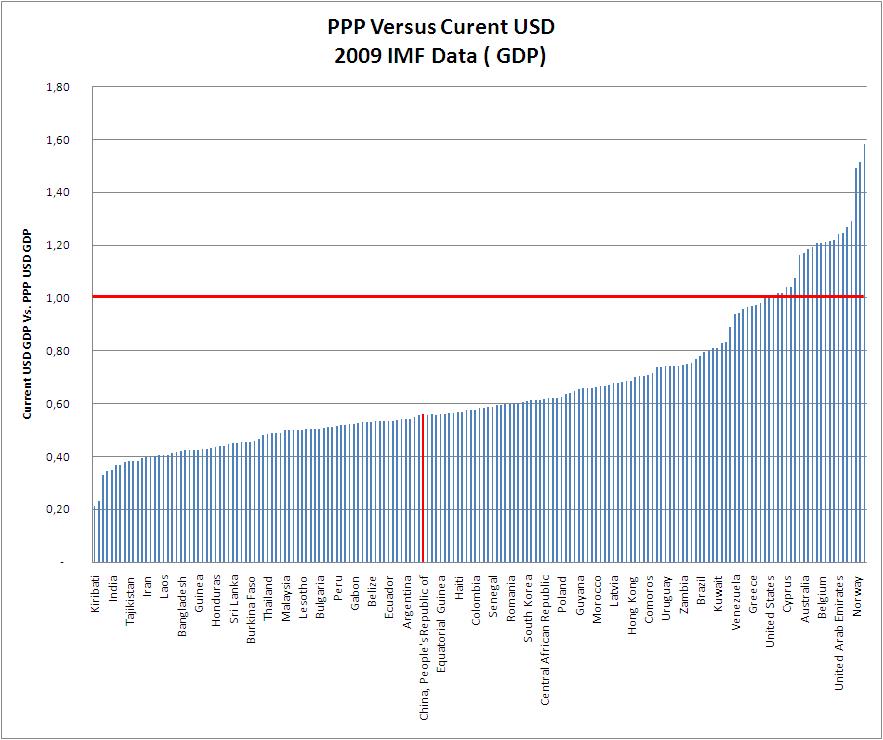
How it is possible to calculate that figure ? PPP measurement method is applied to the overall economy by translating the production of the country from local currency ( Prices x Quantities = GDP ) to USD ( at current USD) and to PPP ( at PPP USD)as well. Since GDP is Quantities multiplied by Prices , we can subtract the quantities from both equations and remain with the ratio between PPP and current USD. A value of 1 would indicate a fair value of the currency and below that a underestimated currency.

With that question in mind I took IMF figures for 2009 and compared between GDP at current and PPP values for the Chinese economy. The result was a ratio of 0.56 , which means that a Greenback in China is able to buy almost the double of products than in US, or that the the Yuan is a “weak” currency since it can buy less products than the USD. The conclusion is that the Americans are right in that specific claims. In any case, the currency exchange value is just part of the story and if we have the whole picture it might change our perception.

First of all, the actual unfair value of the Yuan is a 16 years old , to be precise since the first mandate of President Clinton, and was maintained along recessions, buoyant years, bubbles... and somewhat eased app. 3 years ago, before the crisis emerged ( 23% devaluation). Therefore, in a wider perspective to claim that the currency "manipulation" is the reason for the actual crisis is a bit strange and dubious claim. On the top of it, the US itself was ( and is still !) interested in that mechanism since it became a central piece in maintaining a steady pressure on local prices , wages and inflation. That mechanism ( including the purchasing of Debt) is one of the explanations to the low inflation and low interest rates in the Western economies along the last 30 years, much more than the Genius of central bankers


Second Point is to analyze the wider context : Is the Chinese low value policy so singular ? According to IMF figures it looks that China low value currency policy is the rule rather than the exception, as most of the countries maintain a low currency lower than the “fair” value. ( see graph)


The third point is related to the distributional aspect of the global economy : As can be seen from the next graph, the low value of the currency is common among poor countries and less common among rich countries. It is not a coincidence : The low value of the currency is equivalent to reducing the international value of the work of the country´s citizens and increasing in relative terms the purchasing power of currencies abroad. Is like giving a subsidy to the foreigners.


This should not take us by surprise. Any tourist who traveled to developing countries has probably asked himself how it comes that the same product or service is sold for such low prices ( in comparison to her country). The same question applies when you shop in the Supermarket and can buy an African pineapple for Christmas Eve at a lower price than a cup of coffee.. The answer is partially related to currency values.

The above graph shows that for the 85% of the humanity, the trading terms of their work is lower than should be , while 15% are above that line. In a less political correct parlor, the exchange rate system seems to be just another mechanism that serves 15% of the world population to exploit the remaining 85% : The work of , for axample a Bangladeshi embedded in the exported products is sold in cheaper terms than it should be while he buys the fruit of rich country products in dearer terms than should be. Good deal, isn´t it?

That detail , that huge advantage for the American consumer will be lost if Chinese appreciate their currency. I guess that Congressmen didn´t mention that,and why should they? After all they don´t get their votes or contributions for the campaign from Shanghai , Cairo or Minsk workers and the cry for "jobs" is nowadays above all. However that is the most serious evidence for the real state of affairs.

Nevertheless, the trading terms should be accommodated to reflect a more just and fair distribution of the fruits of the human labor. I would suggest to improve the working conditions, the social security and the wages in China and everywhere in the third world . Such a policy will not only improve the competitiveness of the American worker but open new markets for the American industries .But that is for another ( or many ) post....

Wednesday, June 23, 2010

Beggar Thy Neighbor OUT, Beggar Thy Roommate IN

“Beggar thy Neighbor” is a term used to describe policy measures aimed to boost the economy of a country at others countries expense . That policy is supposed to improve the competiveness of country through different means , just to mention a few : The formation of economic barriers for foreign competitors, a forced devaluation the currency and so on.

True, such “Win-Loose” strategy can generate some limited economic impact. However, history tells us that things can turn into a ugly story: "A form of this policy, notably the tariff barrier, was attempted at the beginning of the Great Depression with almost no success. A beggar-thy-neighbor policy in the United States caused other countries to follow suit, resulting in a massive decrease in international trade. This made the Depression worse.” Financial Dictionary). Retaliation became the key word in that context.

Was the lesson learnt? Up to a certain point. The calls for protectionist measures heard lately were not ( still) able to bring about a policy change and governments declare their commitment to open trade . But that´s not the whole story: Fearing from the neighbors’ response, countries turned to beggar their own poorer roommates. After all someone should pay for the party ....

The Spanish case will illustrate the last point. Spain is suffering from a combination of deep recession, current account deficit, soaring public deficit and huge unemployment rate (app.20%). Before becoming a full EU member , Spain used to overcome similar episodes by literally beggaring its trade partners, especially devaluating its currency, the Peseta ( and other policy tools as well). It had some limited impact when combined with other policy tools.

Spain membership in the EU brought about the loss of independence of its economic policy. Thus ,as many “experts” claim, the only way open to the country is an “internal devaluation”, or in a less PC parlour , lower salaries. The logic goes like that: Spain should gain competitiveness so the prices of Spanish prices must be lowered. Since such arbitrary reduction cannot be forced, (and companies might ,G-D forbid, lose money), the burden should fall on the regular cannon fodder, the wage earner ( lower salaries = lower cost = lower prices ). Moreover, that theory holds a moral argument : Spanish wages have risen “too much” in the last years, and THAT distortion explains the uncompetitive position of the economy. This position (held by the Nobel Laureate P. Krugman), could sound reasonable…. as long as you don´t analyze the data.

Lets see the data. The following graph shows the relative weight of the salaries in the Spanish economy, in other words how much of what the country goes to the pockets of the wage earners. (until 2009 real 2010 onward Forecast)


Source : Eurostat Data Compensation of Employees percentage of GDP

What is the meaning of the descending line? It means that for each Euro produced by the economy (similar to the price of a product in a private company),the workers received a smaller slice than what they used to receive a few years ago. Even if we accept the “loss of competitiveness” thesis, it is hard to see how it is related to the “growth” of salaries. If Spain suffered from a higher inflation rate than its trade partners, it was probably related to the rising prices and profits of the companies and less to the salaries . Although other European workers suffered from the same problem, in comparison to the European wage earner, the Spanish worker has suffered more .

But governments are not confused by facts. The “Socialist” Government already embraced the narrative that reduced social rights and lower salaries is the key for Spain´s recovery. Under the blessing ( or pressure) of the IMF, EU, Obama…etc…. the Government already marked the path by a 5% cut of wages in the public sector. The next step was the adoption of a set of decrees which overturn essential social rights (some of them dated from the Franco era!) including a dismissal "easy track" and a planned assault on the system of collective negotiation and pensions.

Spain is just a model though the narrative is being noticed in other countries. So from now on say "Beggar your neighbor OUT, your worker IN...." . That is the newspeak we´ll hear from now on from policy makers and the financial media. I humbly dare to foresee that the "beggar" policy is deemed to fail as it failed 70 years ago: it will pres each and every country to a lower salaries policy which will eventually depress consumption and economic activity.

I wish policy makers understand, before it gets really too late, that "beggar" cannot replace genuine and progressive economic policy. Moreover, it is more than the beggary policy is the path toward higher levels of despair and anger.

Sunday, June 13, 2010

Green Shots , At Last

The influential “Financial Times” published a week ago an article titled “Time to Plan for a Post Keynesian era“ by the famous Economist Jeffrey Sachs. So what?
Let me skip a large and obscure introduction and go directly to one of the punch lines in that article:

“.....Governments are fighting for market credibility via draconian cuts in spending. This too is the wrong approach. We should avoid a simplistic austerity to follow the simplistic stimulus of last year...... …...Here are some suggested guidelines.....
….Fifth, governments and the public should insist that the rich pay more in income and wealth taxes – indeed, a lot more. The upward re-distribution of the past 25 years has made our economies into extravagant playgrounds for the super-wealthy. Politicians of both the mainstream left and right in the US and UK have fawned over those who pay their campaign bills in return for low taxation. Even playgrounds should collect tolls – when it is billionaires in the sandpit…....


Just in case you are not familiar with the Sachs let me quote Wikipedia “.....One of the youngest economics professors in the history of Harvard University, Sachs became renowned for implementing economic shock therapy throughout the developing world and in Eastern Europe …...” So here we´ve got a mainstream, not only an Harvard Proffessor, but a “shock therapist “ in favour of “more income taxes” ? THAT is a real Green Shot!!

I do not know whether Sach is alone in his approach and what is exactly his diagnosis but Sach´s message is encouraging . I hope more economists would start to adopt a more critic perspective toward the ruling dogmas in order to provide enduring solutions.

A personal note : This blog has been asserting along the whole crisis for the last two years that the crisis should be analyzed from a distribution persepctive : In other words “bailouts” , “quantitative or “qualitative” easing are not more than a curtain of smoke that will eventually proved to be  useless.

This blog still thinks that the current economic crisis is the result of a a the skewed income and wealth distribution int he world ( you are invitd to read previous posts ) . Thus the only human and reasonable solution for the crisis is the construction of mechanism to redistribute income and wealth. Any alternative should be banned from the outset , not only on moral and social grounds, but rejected from a “pure” economic perspective. Sach´s article could be atoner sign that this persepective is being taken seriously .

For those with a bit of patience between the football games I attached the article .... .


Time to plan for post-Keynesian era
By Jeffrey Sachs
Published: June 7 2010 22:22 | Last updated: June 7 2010 22:22

Mainstream Keynesian economics is facing its last hurrah. The global fiscal stimulus championed last year by the Obama administration is coming undone, repudiated by the same Group of 20 that endorsed it last year. Now, against a backdrop of a widening sovereign debt crisis, we need to abandon short-term thinking in favour of the long-term investments needed for sustained recovery.

Keynesian stimulus was premised on four dubious propositions: that it was needed to prevent a global depression; that a short-run fiscal boost would jump-start the economy; that “shovel-ready projects” could combine short-term cyclical and long-term structural agendas; and, last, that the rapid rise of public debt occasioned by stimulus need not be a concern. That these ideas were so widely accepted was a testament to the perennial political attractiveness of tax cuts and spending increases. In fact, the ubiquitous references last year to the Great Depression were glib; the policymakers had panicked. Adroit central banking could and would prevent depression.
 
The hastily assembled stimulus packages were a throwback to naive Keynesianism. The relevant fact was that the US, UK, Ireland, Spain, Greece and others had over-borrowed for a decade, so a decline in consumption after 2007 was not an anomaly to be fought but an adjustment to be accepted.

Certain counter-cyclical spending is vital on social grounds. But stimulus measures such as temporary tax cuts for households or car scrappage schemes were dispiriting wastes of scarce time and money. They reflected a hope that a temporary fiscal bridge would carry us back to consumption and housing-led growth – a dubious proposition since the old “normal” had been financially unsustainable.
The talk of a green recovery, in which the fall in consumer spending would be offset by investments in sustainable energy, made sense and still does. Yet it was quickly undermined by the politicians’ insistence on “shovel-ready” Projects. The shift to sustainable energy systems is a vital but long-term task. It could never be a short-term jobs
programme. Maybe in China there are shovel-ready projects of sufficient scale, but not in. the US.
Taking office in January 2009, President Barack Obama inherited the largest peacetime budget deficit in US history. By increasing it further, he made it his rather than his predecessor’s. He and his advisers ignored one of the key insights of modern macroeconomics: that the result of fiscal policy depends not only on current taxes and spending but also on their expected trajectories in the future.  The US was not in a credible position to raise an already enormous deficit “temporarily” because the prospect for future deficit cutting was and remains extremely clouded.
 
America has absolutely no consensus on how to restore budget balance, as it is trapped between a federal government that provides too few public investments and services and a public that is almost maniacal in its opposition to tax rises. One cannot build a credible long-term fiscal policy by starting off in the wrong direction, with larger rather than smaller deficits. Now we face a world economy with weak aggregate demand in the US and Europe, bulging budget deficits, sovereign debt downgrading and consumers unwilling to borrow. Governments are fighting for market credibility via draconian cuts in spending. This too is the wrong approach. We should avoid a simplistic austerity to follow the simplistic stimulus of last year. 
 
Here are some suggested guidelines.
First, governments should work within a medium-term budget framework of five years and within a
decade-long strategy on economic transformation. Deficit cutting should start now, not later, to achieve manageable debt-to-GDP ratios before 2015.
 
Second, governments should explain, and the public should learn, that there is little that economic policy can do to create high-quality jobs in the short term. Good jobs result from good education, cutting-edge technology, reliable infrastructure and adequate outlays of private capital, and thus are the outcome of years of sustained public and private investments. Governments need actively to promote post-secondary education.
 
 Third, governments must of course also ensure social safety nets: income support for the poor, universal access to basic healthcare and education, a scaling up of job training programmes and promotion of higher education
 
Fourth, governments should steer their economies towards needed long-term structural transformation. External-deficit countries such as the US and UK will need to promote exports over the next few years, while all countries must promote clean energy and new transport infrastructure.
 
Fifth, governments and the public should insist that the rich pay more in income and wealth taxes – indeed, a lot more. The upward re-distribution of the past 25 years has made our economies into extravagant playgrounds for the super-wealthy. Politicians of both the mainstream left and right in the US and UK have fawned over those who pay their campaign bills in return for low taxation. Even playgrounds should collect tolls – when it is billionaires in the sandpit.
 
 We need, in sum, to reset our macroeconomic timetables. There are no short-term miracles, only the threat of more bubbles if we pursue economic illusions. To rebuild our economies, the watchword must be investment rather than stimulus.

The writer is director of The Earth Institute at Columbia University


Thursday, December 24, 2009

Income Distribution ,Bubbles and the Finacial Media

An interest comment regarding the link Debt Bubbles -Income Distribution is presented in this post
The text was published last week at the Financial Times (FT) website and it´s not more than an answer from FT Chief economic Commentator (M. Wolf) to a question raised by a reader. I found the text very interesting as it reflects a seemingly stubborn position of avoiding any serious debate on the above link or alternatively the reejction of any alterantive proposal on economic, political, “theoretical” or practical ground. M. Wolf´s text (FT) is followed by my comments to highlight the main issues in the text

FT : “I am not at all sure about the link between inequality and the bubble. I think that the growth of the financial sector played an important role in increasing inequality in the US and UK. It helped a very small proportion of the population to extract a large amount of rent.”

First of all we can notice that the rise in inequality is undeniable but the real denial is the link to bankers´ greed (the preferred scapegoat) rather than referring to a possible systematic flaw. A serious answer should point to the question of WHY the financial sector expanded to a degree it became a danger to the system and what interests that expansion served. Another interesting point is the irrelevant focus on national (“US and UK”) perspective: even FT agrees that the economic system and the crisis are global, so any economic analysis should be done also from a global perspective.


FT : “…But I am not sure about the reverse causal relationship from higher inequality to the bubble. The argument would, I suppose, be that, lacking higher incomes, a large proportion of the population borrowed in order to sustain consumption. This is possible. But I do not know of any convincing arguments for the proposition”.


The FT previous affirmative tone turns to a more skeptic when he refers to “the reverse causal” (from inequality to bubbles) ,Is it because this causation might oblige us to deal with systematic flaws? Anyhow, this causation seems to be treated as some curious and rather exotic perspective “ I suppose… This is possible… “ are expressions of not taking too seriously the argument. The commentator bothers to specify that “there is no convincing argument for the proposition…”, although a coherent exposition should tell the reader if there are also (not convincing) arguments against the proposition: Maybe there are no evidences against the proposition? Anyhow, there is no mention of any real study about the topic, a weird intellectual lacuna for a discipline like economics that investigates extensively almost any human and social phenomena. Very weird indeed.

FT : “…..In any case, whatever the causal relationship, I cannot see how a more equitable distribution of income would now help solve the crisis. I suppose one might argue that it would increase sustainable consumption, though consumption already looks excessive in the US.

Despite the admission of the ignorance about the topic (“whatever…”), there is no doubt about the conclusion, which is declared in an affirmative tone: “An equitable distribution would not help to solve the crisis”….. So we already admitted that we don´t really know (or pretend that we don´t know) ANYTHING about the issue but we DO know that the solution is not that redistribution ? Doesn’t sound very coherent….

FT ” …I think one would have to argue, instead, that greater equality is a good in itself. The big question is how one could achieve it. There are limits, I think, to how much redistribution one can achieve through the redistribution of pre-tax incomes. So the aim should be to alter the distribution of pre-tax incomes themselves. I know of no easy way to do this, certainly not in the short run”


Now we leave the economic arena to the philosophy realm: Even if we agree that a more equitable society is desirable (which is not an economic issue …), the technical obstacle would be a substantial impediment. Were technical considerations relevant when governments rushed to pour trillions of taxpayer money into failing financial institutions creating the worst moral hazard behavior? How it comes that technical aspects become important whenever we deal with distribution policies, even those considered logical ?And if a measure is right for its own merits, should the easiness of its implementation be an obstacle?

As we have seen along that post, the level of the debate got plenty of room for improvement. Anyhow, the evident attempt to avoid a serious debate on that matter is becoming an unsustainable tactic, so I guess the media and the establishment will intensify the arguments against the calls for a more equitable distribution. On my opinion, the income and wealth more equal redistribution is not only justified by moral foundation but is the only way out from the sub consumption crisis we are stuck in.

Tuesday, October 27, 2009

Distribucion de Riqueza y Crisis Economica ( Spanish)

El breve documento es un resumen en un modesto intento de arrojar luz sobre uno de los aspectos relacionados con la actual crisis económica pocas veces tratado: la relación entre la formación y el estallido de la burbuja de crédito y las tendencias en la distribución del ingreso y la riqueza. El espacio limitado de este blog me obliga a tratar el tema de una forma bastante esquemática , cubriendo solo aspectos generales y especialmente los acontecimientos de la última década, centrándome en EE.UU. debido a su posición dominante en la economía global y la disponibilidad de datos.

Se reconoce comúnmente que el detonador de la actual crisis ha sido el colapso de la burbuja crediticia que se ha venido desarrollando en EEUU desde los años 80 del siglo pasado. Durante estos últimos 30 años la relación crédito / PIB aumentó de un nivel estable (hasta el 80) de ap. 100% hasta un nivel de 350% en 2007. Este nivel de endeudamiento no se veía desde el estallido de una crisis financiera del 1929 que llevó a la Gran Depresión de los 30. La parte del león del aumento de la deuda estaba en las instituciones financieras y los hogares. Resumiendo, se trata de un fenómeno casi sin precedentes y la correlación entre las crisis y la formación de la burbuja crediticia y el posterior estallido de las crisis ( Minsky ) es evidente.

Analizando el asunto desde una perspectiva mas teórica: Deuda, por definición es una transferencia temporal de recursos entre prestamistas y prestatarios. Viéndolo de esta manera, podemos analizar el tema desde la burbuja crediticia desde una perspectiva de ambos lados. Desde la perspectiva del endeudado nuestro análisis sostiene que la expansión de la deuda, especialmente del sector de los hogares americanos esta vinculada al deterioro de los ingresos de la mayoría de los ciudadanos Americanos en términos relativos y absolutos. El endeudamiento masivo sirvió para contrarrestar los efectos negativos relacionados con el estancamiento del ingreso medio ( no promedio!!) por hogar que se mantuvo estable en términos nominales desde 1998 sobre el consumo agregado (Ap. 70% del PIB) y el crecimiento constante del PIB ( ap. 3% anual) . La magnitud de la tendencia se refleja en la creciente brecha de la distribución de las rentas desde los años 80: sólo para la ilustración, el ingreso del 1% mas rico en EEUU antes de impuesto sobre la renta total subió del 9% en 1976 hasta 21,8% en 2005 (el máximo anterior en 2008 fue de 23,9%). O sea los mega ricos aumentaron su participación en la riqueza por más del doble mientras que los ingresos del “ Average Joe”.

El punto de vista del prestamista seria el próximo paso: la distribución desigual del ingreso y la riqueza entre los estratos de ingresos más altos (estudios de la Fed muestran una relación de ahorro más elevada entre los quintiles más altos) formaron una enorme masa de riqueza disponible y prácticamente obligaron al sistema financiero a encontrar salidas a esa masa de , canalizadlos a los mercados financieros y el consumo. Algo parecido sucedió en los años 80 cuando el enorme flujo de petrodólares fue canalizado por la banca a América Latina, causando posteriormente varias crisis de deudas.

Viendo el esquema desde punto de vista de las corporaciones, parecía que el círculo estaba cuadrado: El estancamiento de los costes laborales junto con la expansión del consumo impulsado por el endeudamiento se convirtió en la combinación perfecta para mayores ganancias y / o salarios más altos a los altos directivos.

Una fuente adicional de financiación para el consumidor estadounidense fue el sector exterior ( países extranjeros) que debido a su propia falta de demanda efectiva se vieron obligados a mantener a flote la economía de los EE.UU. mediante la compra de las obligaciones publicas y privadas de Estados Unidos y creando un tasa de déficit de mas de 2 Billones de USD al dia!. El caso de China es interesante, ya que la política de desarrollo del país como el taller del mundo se basa en los costos laborales bajos, y las tasas de ahorro elevadas debido a la falta de red de seguridad social produce una débil demanda interna ( siguiendo la tesis "Que algunas personas hacerse ricos primero" de Deng Xiao Ping). La consecuencia de esta política mercantilista es una dependencia brutal en la demanda externa para garantizar una tasa de crecimiento acelerado para absorber la inmigración de población rural , lo que obliga a los Chinos a mantener un tipo de interés fijo con el dólar a pesar de un enorme superávit en cuenta corriente (especialmente desde 2004) y el flujo de capitales. La consecuencia era inevitable la acumulación de reservas ( de casi 2 billones de dólares a partir del 12/2008), aparentemente muy por encima de las necesidades reales de la economía china.

En algún momento el régimen comenzó a ser sostenido por el aumento de los precios inmobiliarios y una política de bajos tipos de interés que “prometia” un aumento eterno del valor de los inmuebles. Además, las expectativas sirvieron como garantía para prestar mas hipotecas sobre el mismo inmuebles. Como es evidente que este sistema no es viable a medio plazo, los bancos prefirieron empaquetar estos prestamos como productos “serios”y fueron vendidos por una comisión, los que les permitió quitar del balance pasivos y poder siguiendo prestando dinero. El crédito de los titulizados creció de 0,5 a 2,5 billones de dólares entre 1996 y 2007 y una fuente de riqueza para el consumidor que se refleja en el amplio uso del plan de financiación a MEW (MEW: Endeudamiento garantizado por el aumento del valor del inmueble) de lo que explica hasta el 3% de crecimiento del PIB desde 2001 (J. Kennedy y A. Greenspan). Dado que el rendimiento económico real de este régimen es bastante bajo (el análisis de la ROE ROA, en contraste de los bancos de inversión, por ejemplo demuestra los pobres rendimientos de las inversiones reales) los bajos intereses y la falta de regulación es esencial para mantener un nivel de rendimientos decente (y bonos de alto para los altos directivos) y para convertir la deuda dudosa en algo mas respetable. El colapso de los valores inmobiliarios marcó el comienzo de la contracción de la deuda (des apalancamiento) que sufrió el generador de consumo y el valor de las garantías.

El colapso de la demanda efectiva tiene muchas manifestaciones, incluidas las cifras récord de desempleo (casi 10% en EE.UU.), el colapso de la utilización industrial , el estancamiento del crédito, caída de los precios de los inmuebles, entre otros. Hoy en día el consumidor estadounidense está agotado y finalmente consciente de que el el estilo de vida de “0” ahorro garantizado por el aumento eterno delos precios inmobiliarios se ha terminado. Están subiendo las tasas de ahorro para cubrir las deudas del pasado y para recuperar el ahorro necesario para jubilarse. ¿Existen sustitutos para el consumidor estadounidense como motor de la "demanda" mundial (aproximadamente el 16% del PIB mundial)? Descartamos el modelo europeo, especialmente el alemán se basa en la demanda externa, y el Japónes que es más de lo mismo (con una enorme deuda nacional), con el agravante que se trata de economías en envejecimiento. China y otros países en desarrollo (BRIC, por mencionar sólo algunos), aplican modelos de crecimiento basados en salarios bajos y distribución del ingreso enormemente desigual (coeficiente de Ginny en 200 M Brasil se acerca a 60) con una dependencia brutal en la demanda externa. En estas circunstancias, es difícil esperar que las empresas privadas para impulsar la demanda a través de inversiones.

El Salvador se convirtió en el sector público, paradójicamente considerado a lo largo de las décadas de oro del laissez faire como "el problema". Las instituciones públicas son hoy en día participan en una mezcla de políticas keynesianas y monetaristas, vertiendo miles de millones de dinero público en planes de rescate para instituciones financieras, industrias, consumidores, etc, y proyectos públicos para reactivar la demanda agregada.

Dejando de lado la cuestión relativa a la eficacia (y la justicia!) De estos esfuerzos, el gasto adicional será financiado de alguna manera en el futuro por los impuestos, la deuda y / o la monetización. Dado que es difícil ver cómo la economía sin estas herramientas (y, a pesar del efecto multiplicador) se encargará de volver a anteriores agregados normal.

Aquí el espectro de distribución de rendimientos en el debate. Si aceptamos las líneas básicas de este análisis, la reactivación de la economía debe incluir un mecanismo de ingresos importante y redistribución de la riqueza a escala global (la redistribución del ingreso en la escala nacional es un pariente cercano al proteccionismo) para asegurar una generación de demanda duradera basada en el principios económicos sólidos.

Sunday, February 22, 2009

Financial Crisis and Wealth Distribution

It is commonly agreed that the detonator of the current crisis was the collapse of the credit bubble which have been developing since the 80. During that period the US Credit/ GDP ratio increased from a stable level up to 350% (a level not seen since the 30). The lion share of the debt increase was at financial institutions and households sectors

By definition debt is a temporal transfer of resources between a lender and a borrower .From the borrower side our approach claims that the debt expansion, especially of the American household sector, served to counterweight the detrimental effects related to the stagnation of the median household incomes on consumption (ap. 70% of GDP). The magnitude of the trend is reflected in the widening gap of income distribution since the 80 : just for the illustration , “Top 1% Pre Tax Income Share” ascended from 9% in 1976 up to 21.8% in 2005 ( the previous peak in 2008 was 23.9%). From the lender side, the vast accumulation of wealth among higher income stratus (Fed surveys show a rather high saving ratios among the higher quintile) was channeled to the financial markets and consumption (Corporations apparently did not need finance due to their positive cash position along the last decade). It seemed that the circle was squared: Stagnating labor cost combined with expanding consumption means higher profits.

An additional source of finance was the foreign sector as a result of their own lack of effective demand which obliged them to keep financing the US economy by purchasing American obligations. The case of China is interesting since the country development policy as the workshop of the world is based upon low labor cost , and high saving ratios which means weak internal demand (“Let some people get rich first“ Deng Xiao Ping ) The consequence was an inevitable accumulation of reserves (almost 2 Trillion USD as of 12/2008) much above the real needs of the economy.

At some point the scheme began to be sustained by increasing real estate prices (and low interest rates). The expectations served to guarantee mew mortgages ( which were packed and sold for a commission) and a source of wealth effect for the costumer reflected in wide use of MEW finance scheme which explains up to 3% of GDP growth since 2001 (J. Kennedy and A. Greenspan). Since the real economic yield of that scheme is rather low (analyzing the ROE in contrast ROA of investment banks for example) the huge leverage and lack of regulation was essential to maintain decent yields (and high bonuses for top managers) and to turn dubious debt into respectable stuff. The collapse of real estate values marked the beginning of the debt contraction (deleveraging) which sustained the consumption generator and the value of collaterals.

Public institutions are nowadays engaged in pouring trillions of public money on bailout plans for financial institutions, various industries, consumers, etc, and public projects to reactivate aggregate demand. Leaving aside the question regarding the effectiveness (and fairness!) of these efforts, the extra expense will be financed somehow and here the distribution specter returns to the debate. If we accept the basic lines of the above analysis, the reactivation of the economy must include a major income and wealth redistribution mechanism on global scale ( income redistribution on national scale is a close relative to protectionism) to ensure a lasting demand generation based upon sound economic principles.